Guides · Updated
Line Up and Wait (LUAW): The FAA’s Nov 24, 2026 Tower Staffing Rule, What Pilots Should Expect and How to Fly It Safely
Updated Nov 25, 2026. This page explains the FAA’s new line up and wait staffing rule, the controller procedures around it, and how to fly LUAW safely. Every fact links to an FAA order, notice or the AIM, or to the NTSB. It isn’t training or legal advice; your clearance and your operator’s procedures govern what you do.
What changed on Nov 24, 2026
FAA Notice N JO 7210.979, LUAW Operations Watch Supervision Requirement (effective Nov 24, 2026) amends paragraph 10-3-8 of FAA Order JO 7210.3, the facility manual for air traffic managers. Two items matter:
| JO 7210.3, 10-3-8 | Before (current HTML order) | From Nov 24, 2026 (N JO 7210.979) |
|---|---|---|
| a.6, supervisor | “The OS/CIC position should not be combined with any other position.” | “A stand-alone watch supervision (OS/CIC) position must be staffed and must not be combined with any other position.” |
| a.4, local control | Local control “must not be consolidated/combined with any other non-local control position,” e.g. the OS/CIC, clearance delivery, flight data, ground or cab coordinator | Same rule, with “watch supervision (OS/CIC)” named in the example. Local control can still be combined with other local positions (local assist, local monitor) and with a Class B/helicopter position that has defined tower airspace. |
The FAA’s stated reason: “By upgrading the guidance from ‘should’ (a recommendation) to ‘must’ (a mandatory requirement), the FAA ensures that the personnel providing watch supervision (OS/CIC) are fully dedicated to overseeing the safety of the operation without the distraction of simultaneously managing other operational tasks” (FAA Notice N JO 7210.979, LUAW Operations Watch Supervision Requirement (effective Nov 24, 2026)). OS/CIC means operations supervisor or controller-in-charge. Under FAA Order JO 7210.3, 2-6-1 Watch Supervision, watch supervision “may be performed by a manager, supervisor, or controller‐in‐charge (CIC)” and includes “managing the operational environment with a goal toward reducing or eliminating distractions.”
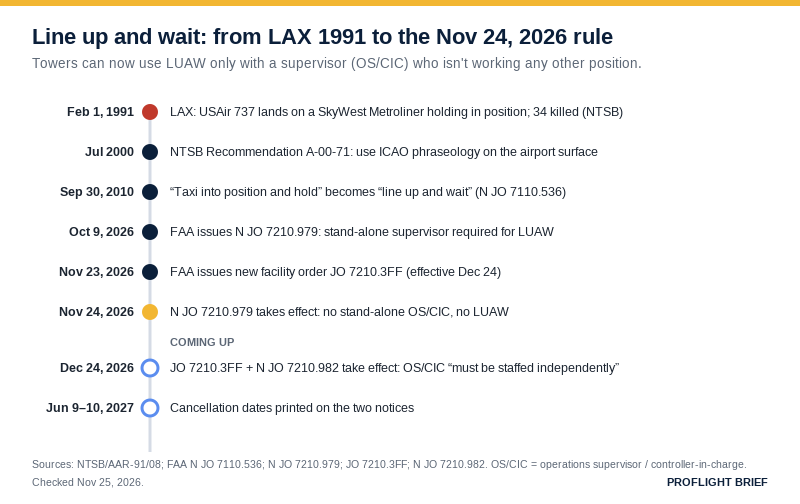
The notice was signed Oct 8 and issued Oct 9, 2026, and its PDF lists a cancellation date of June 9, 2027 (the FAA directives page lists June 10, 2027) (FAA directives page for N JO 7210.979).
What happens after Dec 24, 2026
The FAA issued a new edition of the facility order, FAA Order JO 7210.3FF, Facility Operation and Administration (issued Nov 23, 2026; effective Dec 24, 2026). In the 7210.3FF basic text, 10-3-8 a.6 still reads “should not be combined.” A second notice, FAA Notice N JO 7210.982, Consolidating Positions (effective Dec 24, 2026), effective the same day, adds a new subparagraph to 2-6-6, Consolidating Positions: “When conducting LUAW operations, the (OS/CIC) position must be staffed independently and must not be combined with any other position.” Its stated purpose is the same as the Nov 24 notice. So the “must” requirement is in both notices; the cancellation dates printed on them are mid-2027.
What it means for pilots this week
- Some towers may stop using LUAW for periods when they can’t staff a separate supervisor. Then you’ll hold short until you’re cleared for takeoff. The notice gives no list of affected towers and no capacity estimate, and we found no FAA statement estimating the delay impact. Which towers are affected: Not published.
- Timing: the rule started the Tuesday of Thanksgiving week. The FAA forecast more than 417,000 flights over the nine-day holiday period, the busiest in 16 years, with Tuesday Nov 24 the busiest day at more than 52,000 flights (FAA Thanksgiving 2026 forecast (Nov 24, 2026)). Check FAA NAS Status for airport delays.
- Nothing changes in the cockpit. The phraseology, readback and pilot procedures are the same. If you do get “line up and wait,” fly it exactly as before (below).
The controller rules around LUAW (JO 7110.65, 3-9-4)
From FAA Order JO 7110.65, 3-9-4 Line Up and Wait and FAA Order JO 7110.65, 3-10-5 Landing Clearance:
- Purpose: “The intent of LUAW is to position aircraft for an imminent departure.” Controllers may not use conditional phrases such as “behind landing traffic.” Phraseology: “RUNWAY (number), LINE UP AND WAIT.”
- 90 seconds: “An aircraft should not be in LUAW status for more than 90 seconds without additional instructions.”
- Landing traffic: without a safety logic system (or with it in limited configuration), the tower may not clear anyone to land, touch-and-go, low approach or option on the same runway while an aircraft is holding in position, and may not put you in position if someone is already cleared to land. Towers with safety logic in full core alert mode may do so, “except when reported weather conditions are less than ceiling 800 feet or visibility less than 2 miles.”
- Traffic call: you’ll be told about “the closest traffic within 6 flying miles” requesting a landing, touch-and-go, stop-and-go, low approach or option on your runway (example: “United Five, Runway One Eight, line up and wait. Traffic a Boeing Seven Thirty Seven, six mile final”).
- Visibility from the tower: no LUAW when the departure point isn’t visible from the tower unless ASDE can verify the aircraft’s position or the runway is departures-only.
- Night intersections: LUAW at an intersection between sunset and sunrise needs service area approval, a facility directive, a departures-only runway and only one aircraft at a time.
- Two at once: no simultaneous LUAW on the same runway between sunrise and sunset unless the local assist or local monitor position is staffed.
- Clearance changes: if the local controller delivers or amends a clearance while you’re holding in position, they must add “HOLD IN POSITION” (or “HOLD SHORT OF RUNWAY”).
How to fly line up and wait (AIM 5-2-5)
All quotes from AIM 5-2-5, Line Up and Wait (LUAW):
- It isn’t a takeoff clearance. “LUAW is not an authorization to takeoff.” The FAA notes that “a significant number of pilots read back LUAW instructions correctly and departed without a takeoff clearance.”
- Watch the clock. FAA analysis of events involving aircraft holding in position found “two minutes or more elapsed” between the LUAW instruction and the event (a land-over or go-around). If you haven’t been told about a delay, query the tower. Example: “Cessna 234AR holding in position Runway 24L.”
- Scan before you enter. Scan the full length of the runway and look for aircraft crossing, on final or on the landing roll, including on intersecting runways. Be especially careful at night, with intersecting runway operations and in low visibility.
- Listen for your call sign and runway. With two or more runways active, several aircraft may be in position at once. If you’re not sure a takeoff clearance was for you, ask before you roll.
- Intersections: ATC will use the intersection designator (“Runway 24L at November 4, line up and wait”). If it’s left out, ask.
- Never land on an occupied runway. “Never land on a runway that is occupied by another aircraft, even if a landing clearance was issued.” ATC will normally withhold landing clearance while another aircraft is in position.
Readback and lights: pilots should always read back “any instruction to hold short of a specific runway or line up and wait” (AIM 4-3-18). When entering the runway to line up and wait, “all lights, except for landing lights, should be illuminated to make the aircraft conspicuous to ATC and other aircraft on approach”; landing lights go on when you’re cleared for takeoff (AIM 4-3-24) (AIM 4-3-18 and 4-3-24). More on clearances at the hold line in our runway incursions guide.
Why the FAA cares: LAX, Feb 1, 1991
From the NTSB’s executive summary (NTSB/AAR-91/08, USAir 1493 and SkyWest 5569, Los Angeles (Feb 1, 1991)): at 6:07 p.m. PST, USAir flight 1493, a Boeing 737-300, landing on runway 24 left at Los Angeles, collided with SkyWest flight 5569, a Fairchild Metroliner “positioned on the same runway, at intersection 45, awaiting clearance for takeoff.” All 10 passengers and 2 crew on the Metroliner and 20 passengers and 2 crew on the 737 were killed. The NTSB found the probable cause was the failure of Los Angeles ATC facility management to implement procedures “that provided redundancy comparable to the requirements contained in the National Operational Position Standards,” and the failure of FAA Air Traffic Service to provide adequate policy direction and oversight. Its listed safety issues include “Air traffic controller workload, performance, and supervision.”
The phrase itself changed on Sep 30, 2010, when “taxi into position and hold” became “line up and wait” to match ICAO. The FAA notice cites NTSB Recommendation A-00-71 (July 2000) asking for ICAO surface phraseology (FAA Notice N JO 7110.536 (effective Sep 30, 2010)). The glossary definition: LUAW is “used by ATC to inform a pilot to taxi onto the departure runway to line up and wait. It is not authorization for takeoff” (Pilot/Controller Glossary (L)).
Helicopter and flight school notes
- Helicopters: the local-control rule still lets a Class B/helicopter position “with defined control tower airspace” be combined with local control. The new supervisor rule has no helicopter exception: the OS/CIC must not be combined “with any other position.”
- Training airports: the AIM’s LUAW examples use a Cessna and a Cherokee. Teach students that “line up and wait” means wait, that “holding in position” is the call after about two minutes without word, and that they should listen for intersection designators. See how to become a CFI and DFW flight schools.
Sources
Checked Nov 25, 2026: FAA Notice N JO 7210.979, LUAW Operations Watch Supervision Requirement (effective Nov 24, 2026); FAA directives page for N JO 7210.979; FAA Notice N JO 7210.982, Consolidating Positions (effective Dec 24, 2026); FAA Order JO 7210.3FF, Facility Operation and Administration (issued Nov 23, 2026; effective Dec 24, 2026) (basic PDF, paragraphs 2-6-6 and 10-3-8); FAA Order JO 7210.3, 10-3-8 (current HTML); FAA Order JO 7210.3, 2-6-1 Watch Supervision; FAA Order JO 7110.65, 3-9-4 Line Up and Wait; FAA Order JO 7110.65, 3-10-5 Landing Clearance; AIM 5-2-5, Line Up and Wait (LUAW); AIM 4-3-18 and 4-3-24; Pilot/Controller Glossary (L) (AIM, P/CG, JO 7110.65 and JO 7210.3EE HTML effective Jul 9, 2026); FAA Notice N JO 7110.536 (effective Sep 30, 2010); NTSB/AAR-91/08, USAir 1493 and SkyWest 5569, Los Angeles (Feb 1, 1991) (executive summary); FAA Thanksgiving 2026 forecast (Nov 24, 2026).
What we couldn’t verify
Which towers can’t staff a stand-alone OS/CIC and have stopped LUAW: Not published. Any FAA estimate of the effect on departure rates or delays: Not published (the notice gives none). We saw press reports that controllers expect delays and that the FAA expects no impact, but we couldn’t read a primary FAA or NATCA statement, so neither is used. Cancellation dates: the N JO 7210.979 PDF says June 9, 2027 and the FAA directives page June 10, 2027; the N JO 7210.982 PDF says June 10, 2027 while the JO 7210.3FF page lists Nov 24, 2028. Whether the FAA will later reword 7210.3FF 10-3-8 a.6 from “should” to “must”: Not published. We read the 1991 NTSB report only through its executive summary.
Looking for employers? Browse the pilot employer & flight school directory.
FAQ
What does “line up and wait” mean?
It’s the ATC instruction to taxi onto the departure runway, line up and wait for takeoff clearance. It is not a takeoff clearance (AIM 5-2-5; Pilot/Controller Glossary). It replaced “taxi into position and hold” on Sep 30, 2010.
What changed for line up and wait on Nov 24, 2026?
FAA Notice JO 7210.979 made a stand-alone supervisor mandatory: “A stand-alone watch supervision (OS/CIC) position must be staffed and must not be combined with any other position.” Before, FAA Order JO 7210.3 said it “should not” be combined. Towers that can’t staff that separate position can’t use LUAW.
Will the LUAW rule cause delays?
Possibly at towers that can’t staff a separate supervisor, because they’ll hold departures short of the runway instead of lining them up. The FAA notice gives no list of affected towers and no capacity estimate, so the size of any effect is Not published.
How long should I wait in position before calling the tower?
JO 7110.65 says an aircraft should not be in LUAW status for more than 90 seconds without more instructions, and the AIM notes that past events happened two minutes or more after the LUAW instruction. If you haven’t been told about a delay, query the tower, e.g. “Cessna 234AR holding in position Runway 24L.”
Can the tower clear someone to land while I’m lined up and waiting?
Only at towers using a safety logic system in full core alert mode, and not when the reported ceiling is below 800 ft or the visibility below 2 miles (JO 7110.65 3-9-4 and 3-10-5). Otherwise the landing aircraft is told “continue, traffic holding in position.” The AIM says never land on an occupied runway, even with a landing clearance.
Is line up and wait used at night at intersections?
Only under extra conditions: service area approval, a facility directive, the runway used for departures only and one aircraft at a time (JO 7110.65 3-9-4; JO 7210.3 10-3-8).
Related guides
- Runway incursions & crossing callout
- FAA ground stops explained
- Pilot in command authority (14 CFR 91.3)
- How to become a flight instructor (CFI)
- Airliner ADs this month
- Pilot duty time & rest rules
- ADS-B In mandate
- Helicopter ADs this month
- Free 2026 Pilot Pay Guide (PDF)
Data checked Nov 2026. Pay and postings change, so verify with the employer. Estimates are labeled.